psychology
This information is a cumulative record of my notes from a six week, three days a week, course in the summer of 2026.
Definitions
Acetylcholine (ACH): Found throughout most of the nervous system. Can be excitatory or inhibatory. In skeletal muslces, allows for
contractions/movement.
Axon: Part of neuron which messages run down.
Cerebellum: Controls posture, balance, coordination, muscle movement.
Cerebral cortex: Mammalian brain, four pairs of lobes.
Correlational coefficient: statistical measure which shows the strength of a relationship between two variables.
Dendrites: Part of neuron which recieves messages.
Dopamine: Inhibatory or excitatory neurotransmitter. Control of voluntary movement (muscles).
Endorphins (endo: inside, orphins: morphine): Natural pain reliever. Can play a part in addictions.
Epistomology: The study of knowledge.
Excitatory: "Fire," increases activity/electrical impulses in cell. Increases likelyhood of neuron firing.
GABA: Gamma amino butyric acid. Primary inhibitor neurotransmitter. Too little can lead to anxiety.
Glia (glial, glue) cells: Found around/supports nerves.
Inhibatory: "Don't fire." Decreases likelyhood of neuron firing.
Limbic system: Manages emotions, memory, homeostasis, motivations.
Misfiring: Something goes wrong in transmission (e.g. myelin degrades).
Myelin sheath: Of a neuron; insulator, protection. Combination of proteins & fats. Allows for faster transmission speeds.
Neuroplasticity: Brains ability for organizing/reshaping itself by forming new neural connections/pathways.
Operational definition: How a concept is measured, observed, and assigned a value and quantified.
Parasympathetic nervous system: Returns body to normal homeostasis; autonomic nervous system.
Reflex: Involuntary action, involving the spinal cord. Triggered by a stimulus.
Reticular formation: Acts like a screen, letting some nerve impulses in. Keeps us alert.
Serotonin: Inhibatory neurotransmitter. Regulates sleep, appetite, and mood.
Serotonin syndrome: Caused by too much serotonin in system. Can be life threatening.
Soma: Cell body, where the nucleus is. Where messages are put together.
SSRIs: Selective serotonin reuptake inhibitors.
Sympathetic nervous system: Fight or flight response; autonomic nervous system.
Synapse: Of a neuron, the gap between dendrite and axon terminal.
Systematic research: done according to a fixed plan; methodical and deliberate.
Tabula vasa: blank slate
Thalamus: Incoming information from senses (except smell; goes directly to where it needs to go; evolutionary) first goes to the thalamus,
then to where it needs to go.
Tryptophan: Found in foods (turkey, dairy), helps create serotonin.
Intro
The scientific field that studies behavior & mental processes. Empirical evidence.
1880s: psychology developed from philosophy (logical, rational arguments), asking how knowledge is possible.
Kant: argued that humans are born with innate knowledge.
Locke: argued it is reasonable to assume knowledge is possible through senses.
Properties of physical world -> properties of our experiences of reality
1920s-50s:
Watson: argues conciousness does not = physchology. Claims we can observe behavior (empircal, scientific evidence), not
conciousness.
1960s: advancement in methods; inferences can be made.
Subfields
i. Clinical:
Patient/therapist, origin and treatment of mental disorders. Practice.
ii. Counseling:
Everday problems (e.g. marriage counseling).
iii. School & Educational:
Dealing w/kids (up to highschool). Disruptive behavior, failing, etc. Effective studying
& teaching.
iv. Developmental:
Systematic changes that occur in mental processes/behavior over time (child -> elder;
milestones). Research field.
v. Social:
The way people influence eachother. Prejudices.
vi. Personality:
The way people are consistent in their behavior. Research field.
vii. Experimental:
Cognition, decision making, learning, physiological. Research & practice.
viii. Industrial/Organizational (IO):
Workplace, organization of environment, efficient workflow. Culture of organization,
communication.
Perspectives and their takes on depression & attraction
i. Biological perspective: biological basis of behavior; nervous system & endocrine system.
Depression: Serotonin levels (neurotransmitter) affects mood. Rather than not making enough, they do not stay in the
synaptic cleft long enough to be picked up by the next neuron (reuptake happens too quickly).
Attraction: Ovulatory cycles -> evolutionary push for reproduction.
ii. Psychodynamic perspective: unconcious determinants (Freud).
Depression: Anger (towards others, e.g. parents) turned inwards.
Attraction: Displaced incestuous desires (oedipus complex). Sensual.
iii. Cognitive perspective: attribution (cause of behavior) style. Thought patterns.
Depression: Blaming failures (contrary, winnings) on self (or others).
Attraction: Beliefs about love (soulmate theory, work it out theory).
iv. Behavioral perspective: understanding behavior as learned through rewards, punishments, and classical conditioning (Pavlov). Reaction to
a stimulus; reinforcement. Observable evidence.
Depression: Learned helplessness.
Attraction: Classical conditioning.
v. Humanistic approach: response to psychodynamic & behavioral perspectives. Everyone has their own motivations, leading to
potential and growth.
Depression: Blocked growth (e.g. being in the wrong environment).
Attraction: Positive qualities of desired mates.
vi. Sociocultural perspective: context of culture & environment.
Depression: Variations in depression rates. Expectations (e.g. gender roles).
Attraction: Cultural variations in love.
Methods
Research Methods
Scientific approach to gaining knowledge: systematic (deciding what, who, etc. you are looking at beforehand; planned steps) observation. Rules
and procedures for asking & answering questions, differentiating scientific knowledge from everyday knowledge = reliable knowledge.
Public (findings and methods) & repeatable; allows for criticism and public discourse.
Cumulative; big picture broken into multiple pieces / questions / studies.
Methods
Correlational studies: relationship between 2 or more variables (anything which has >1 value; e.g. age).
If 2 variables are related, knowing the value of 1 variable can tell the value of the other.
Operational (procedures by which we assign a value to x; how we go about it) definitions of values. Helps in finding how to assign a
value to abstract ideas (e.g. anxiety, happiness).
Operational definition vs What people tell you
Surveys (self report), examining public records, etc.
Flaws: Errors, participants lying (intentionally or unintentionally), mistakes in records, limitations, etc.
Assigning tests/questionaires to find values (e.g. personality test to determine anxiety levels).
Correlations
No correlation: Knowing 1 value does not give information on the other; independent.
Positive correlation: Increase/decrease in 1 variable leads to an increase/decrease of the other. Positive line slope: /
0 . . . . . 1
Negative correlation: Increase in 1 variable leads to a decrease in the other (or vice versa). Negative line slope: \
-1 . . . . 0
Spurious correlation: Looks like a correlation, but isn't.
Correlational coefficient:
Correlations do not tell us about causation (what causes what).
Possibilities: must follow logic.
A may cause B / B may cause A / Some third factor may affect both A & B seperately
Experimetnal studies
Allow us to make strong inferences on cause & effect relationships by controlling (manipulating) one variable and seeing what happens to the
other.
Requirements for a good experiment:
i. Random assignment to groups
ii. Only variation in the experiment is the independent variable, everything else must be the same; controlled environment and experience.
Ethics
IRB: Instiutional Review Board
Consists of researches, students, the public, and judge the ethics of the study. Independent of the researcher.
Ethical issues arise in the treatment of participants.
Must assess risk for harm, get informed consent, offer debriefing (option to recieve an overview of details on the study afterwards). Participants
have the right to terminate participation without penalty (still recieve e.g. money, course credit, etc. despite not finishing study), preventing
participants from feeling "trapped" in the study. Confidentiality & privacy.
Case study: Milgram's Experiment on Obedience to Authority
Participants became
distressed at administrating (fake) electrical shocks, showing the need for an ethical examination for the field.
The Biology of Behavior
Nervous system
Nerves: Series of neurons, organized in similar functions.
Neurons: Basic cell, transmission of information from the outside world or body -> inside world.
Interneuron: Nerve that links a sensory neuron & motor neuron.
Soma: Cell body, where the nucleus is. Where messages are put together, deciding whether or not to send message.
Dendrites: Info comes in. Messages transmitted from axon terminal button -> dendrites; chemical reaction.
Axon: Movement of information down axon. There are slow (~5mph) and fast (~250 mph) neurons.
Myelin sheath: Insulator, protection. Combination of proteins & fats. Allows for faster transmission speeds.
Synapse: The gap between dendrite and axon terminal. Chemical reaction in synaptic vesicles.
Glia (glial, glue) cells: Found around/supports nerves. Involved in (but not directly part of) nervous system. Nourishes neurons,
bringing nutrients from blood stream, and directs neural growth. Neural pruning: starts in adolesence, cuts away unneeded/unused pathways to keep
efficient/used ones. Makes myelin.
Two kinds of messages in nervous system, opposing forces:
Excitatory: "Fire," increases activity/electrical impulses in cell. Increases likelyhood of neuron firing.
Inhibatory: "Don't fire." Decreases likelyhood of neuron firing.
Threshold for firing: excitatory:inhibitory ratio.
All-or-none law: Neurons either fire, or they don't.
More intense stimuli: Neurons fire more times in a row.
Diameter of axon: smaller (slower); thicker (faster); pain signals are generally thicker.
Misfiring: Something goes wrong in transmission (e.g. myelin degrades). Demyelinating disorders: destruction of myelin (e.g.
multiple schlerosis: breakage in random places in nervous system; vision problems, muscle control, unpredictable, can be progressive).
At birth: Myelinated nerves are incomplete.
Reflexes: Involuntary action, not involving brain (involves spinal cord). Triggered by a stimulus. Seen most clearly in children
(breathing reflex, swallowing reflex, grasping reflex).
Moro reflex: Startle reflex observed in infants, triggered by sudden disruptions in body balance or extreme stimulation.
Babinski reflex: Triggered by stroking bottom of foot, causing big toe to extend and other toes to fan out. In older children and
adults, signals a CNS disorder.
Rooting reflex: Reflex which helps newborns to feed.
Neurotransmitters
Hundreds, functions vary. Same neurotransmitter can have different functions depending on the nerve it is in. Excess neurotransmitters: reuptake
into sending synapse & stored.
Acetylcholine (ACH): Found throughout most of the nervous system. Can be excitatory or inhibatory. In skeletal muslces, allowing for
contractions/movement. May play a role in memory. Botox is a local acetycholine blocker.
Serotonin: Inhibatory. Located in CNS (brain & spinal cord). Regulates sleep, appetite, and mood. In depression, reuptake of serotonin
happens too quickly.
Tryptophan: Found in foods (turkey, dairy), helps create serotonin.
Dopamine: Inhibatory or excitatory neurotransmitter. Only found in brain. Control of voluntary movement (muscles).
Not enough: can lead to Parkinson's disease. Symptoms include involuntary tremors, difficiulty walking, rigidity in face, psychology symptoms
e.g. delusions and hallucinations. Affects pleasure centers & capacity to learn and feel rewards. Can be preogressive. No treatment: difficult to
get dopamine into brain due to the blood-brain barrier. Unknown why people get it.
1916-1920: Increased diagnosis of Parkinsons. Unusual flu happened around the same time, hypothesized that the virus could have contributed to
developing Parkinsons.
GABA: Gamma amino butyric acid. Primary inhibitor neurotransmitter. Found in brain & spinal cord. Too little can lead to anxiety.
Endorphins (endo: inside, orphins: morphine): Similar molecular structure to opioids; natural pain reliever. Produced when
running/working out/eating spicy foods. Can play a part in addictions.
SSRIs: Selective serotonin reuptake inhibitors.
Serotonin syndrome: Caused by too much serotonin in system. Can be life threatening.
Ectasy: Releases serotonin and destroys axon terminals.
Neuroplasticity: Brains ability for organizing/reshaping itself by forming new neural connections/pathways. If one part of the brain is
damaged, another part can take up its role.
Action potential stimulates synaptic vesicles to secrete chemicals into the synapse, synaptic fluid into receptor (dendrites).
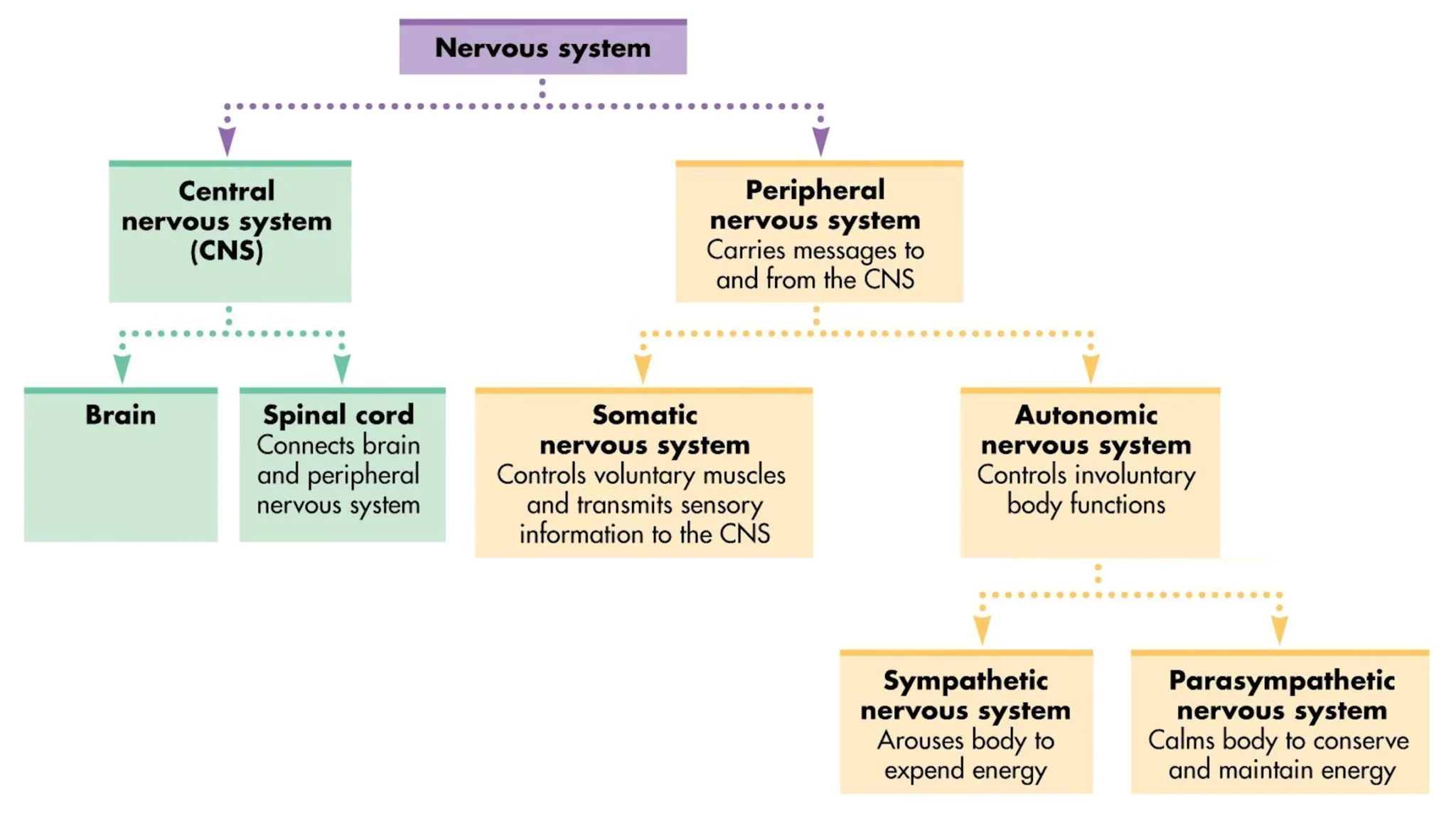
Autonomic Nervous System: Sympathic Nervous System
Fight-or-flight response: mobilizes body.
Energy output: towards survival.
Respinse to a percueved threat.
-Pupils dialate: take in more light to see better.
-Slows salivation, digestion slows: dry mouth, energy priority.
-Heart rate accelerates: increased blood flow & oxygen throughout the body.
-Lungs swell: increased surface area, intake more oxygen.
-Increased sweat: producing more heat/energy, regulates temperature.
Parasympathetic Nervous System
Conserves energy.
Returns body to normal homeostasis.
-Pupils constrict.
-Salivation returns, digestion returns to normal.
-Heart rate lowers.
-Lung capacity returns to normal.
-Sweating stops.
Both systems are always activated to some degree.
The Brain
Cerebellum: "little brain"
Manages:
-Upright posture, balance.
-Coordination.
-Muscle tone (tension): movement.
Alcohol interferes with its function. Difficult to balance on one foot with eyes closed.
Reticular formation:
Lacy-like network of nerves.
Acts as a "screen," letting some nerve impulses in, but not others; limits flow of information.
Priority impules get through (e.g. pain signals).
Reticular activating system (RAS).
-Keeps us alert, relatively high state of awareness.
-Can send stimulation to higher levels of the brain.
-Can prevent stimulation from getting through (e.g. during sleep).
-Responsible for "highway hypnosis."
Thalamus:
Incoming information from senses (except smell; goes directly to where it needs to go; evolutionary) first goes to the thalamus,
then to where it needs to go.
Injury unlikely: due to it being deep in the brain, physical injury would lead to death; leisons, for example, could happen though.
Synesthesia: recieving stimulation in one sense, but experiencing it in another (e.g. seeing red & hearing a tone). Unsure why it
happens; one theory is that there is a stray nerve which goes to the wrong area.
Limbic System: Hypothalamus ("under")
Control center for emotions & motivations.
-Sex, arousal, appetite, intense emotions (e.g. rage).
Keeps homeostasis (body in balance; e.g. shivering when it's cold).
Limbic System: Amydgala
Almond shaped.
Controls emotions; connections between emotional states & outside world; e.g. remembering that something makes you fearful.
Rats with an altered amygdala display intense anger/aggression; with the amygdala removed, they do not experience fear.
Limbic System: Hippocampus
Looks like a seahorse.
One on each side of brain.
Memory formation; short term -> long term memories.
Locate/recognize space, the arrangement of things in a room (spatial memory, "mental map" of environment).
Experience can change the size/volume of the hippocampus: cab drivers tend to have more volume (correlation studies;
plausable that being a cab driver leads to a larger hippocampus, or having a larger hippocampus leads to being more likely to
get hired as a cab driver); positive correlation: the longer someone has been a cab driver, the larger the hippocampus: consistent
with the theory that being a cab driver leads to increased volume.
Cerebral Cortex: "new brain," "mammalian brain"
All mammals have a similar structure
4 pairs of lobes; anatomical divisions
Frontal lobes:
Executive functions
-Ability to plan
-Decision making
-Rational thought
-Impulse control
-Personality, emotional lives
-Motor activity
Not fully developed until early 20's.
1940s: development of the lobotomy, reduce/eliminate symptoms of mental illness when altering the frontal lobe.
Broca's area: involved with the production of language.
Transfer thoughts -> words
Motor movements; muscles of tongue, lips, etc.
Stroke damage: difficulty speaking; short, choppy sentences, missing words.
Temporal lobes:
Language, hearing, identifying sounds, recognizing faces, visual info.
Wernickes area: reading, extracting meaning from words & understanding speech
Visual impulse -> auditorial impulse; variations when reading (hearing the words in your
mind, or not).
Damage: e.g. stroke; difficulty understanding speech/reading.
Parietal lobes:
Primary place where tactile information, smell, and taste occur.
Occipital lobes:
Primary place where vision occurs.
Somasensory, motor, & association cortex: link incoming messages
Primary sensory cortex: visual, auditory, etc.
Set to respond to little pieces/elements of the big picture (e.g.: auditory: recognizing pitch, tone, etc.).
Sensory association cortex: visual, auditory, etc.
Assembles the elements into the final product.
Primary cortex --incoming picture-> association cortex
Higher association cortex
Not tied to one sense; all kinds of inputs associated.
Thought, learning.
Stimulus & emotional response.
Bigger patterns.
More area given to various association cortexes, more intelligent the species (e.g. mice have very little higher association cortex).
Corpus callosum: Seperates the hemispheres of the brain. Thick band of nervous tissue. Lateralization of the brain.
Left and right hemisphere are both similar & different; specializations (below; ~95% of humans follow this pattern).
Left hemisphere controls the right side of the body; right hemisphere controls the left side of the body.
Left Hemisphere
Vision: left side of the left eye is sent to the right hemisphere, right side of the left eye sent to the left hemisphere; vice versa.
Left Hemisphere:
Analysis, sequential processing, details, specifics, logical.
Language (speaking, writing, understanding).
Mathematical thinking/operations.
Time (subjective) and rhythm (music, language).
Peoples names.
Coordinating order of complex movements (e.g. writing, walking).
Damage: can include paralysis on right side; speech/language deficits; slow, cautious behavior; memory (language) deficients.
Right Hemisphere: Holistic, simultaneous processing, overall patterns, general connections.
Simple language & number (e.g. counting).
Recognizing patterns (faces, melodies).
Detecting & expressing emotions (verbal, nonverbal, tone of voice e.g. sarcasm).
Damage: can include paralysis of left side; spatial/perceptual deficits; quick, impulsive behavior; performance memory deficits.
Sensory and Perception
The world is created by our sensory percetions; limited by our senses.We respond to physical energies:
- Light
- Sound
- Temperature
- Pressure
Sensation: Registering sensory input (e.g. hearing/seeing something). Passive process.
Perception: Recognizing what that thing is, connecting it to something we know; making sense of sensation. Activate process, selective process (reticular formation screens out information). Shaped by prior knowledge, needs & emotions, characteristics of object and/or context.
Change blindness: missing an obvious change.
Change blindness experiment Bruner: proposed the "new look" in perception; it is not mechanical, but is guided by emotional needs.
When hungry, participants were more likely to list down food related items from a collage of images.
Salience: property of an object to stick out.
Novel stimuli: never or rarely encountered before.
Unusual stimuli: never or rarely encountered within context of situation.
Emotionally charged stimulus: associated with strong emotions (e.g. the "cocktail party effect" of overhearing your name in a busy room).
Loftus "weapon effect" people are less likely to report accurately if a weapon was present. A persons confidence in their own accuracy does not = accuracy (not correlated).
Perception is organized.
Bottom-up processing: bits and pieces assembled, interpreting information as it comes in; solving a jigsaw puzzle by looking at the pieces.
Top-down processing: holistic processing, using prior knowledge & experiences to interpret sensations, efficient & quick; solving a jigsaw puzzle by looking at the box.
Gestalt processing: "form-shape" processing, the whole is greater than the sum of its parts; guided by higher cognitive processes.
General Properties of Sensory Systems
Auxillary structures: Move the energy from outside -> receptors.
Sensory receptors: Specific neurons fire off in response to a particular range of physical stimuli. Neurons respond to specific stimuli; what we know about the world depends on what our nervous system is tuned to.
Data reduction systems: It is impossible to get a complete picture of the world; it is simplified.
Transducers: Any device (mechanical or biological) that converts one form of energy to another.
e.g. Kinetic energy: movement.
We see not with our eyes, but by means of our eyes.
Human Limits
Psychophysics: Studies the relationship between physical stimiuli & the sensations they produce.
Absolute threshold: (for a sense) minimum amount of energy necessary to register somethings there; individual differences in senses.
Difference threshold: (for a sense) minimum amount of energy needed for us to percieve a change in a stimulus.
Limen: Threshold
Below: subliminal
Above: supralimial
Weber: explored the difference threshold, wondering if there are general principals of the world; aimed to measure each sense. Proposed the
just noticable difference (JND), a standard unit measure for the difference threshold for any sense, allowing for comparisons. JND depends on the intensity of the initial stimulus.
Webers law: a JND is a constant fraction of the intial stimulus.
ex: (if difference is noticed)
10w . . . . . 15w
5w/50% increase
then
20w . . . . . 30w : 10w increase (50% of initial stimulus) needed
Objective amount increase, but not noticed.
Empirical law of subjective experience.
Sensory adaptation: decreased sensitivity to a stimulus after prolonged exposure to it (e.g. getting used to cold water); subjective experience changes.
Sensory systems have evolved to be sensitive to change. Only exception is vision, one of our most important senses; we never have prolonged exposure to the same visual stimulus (eyes never still), and if we were to "adapt" to a dangerous stimulus, it could be the difference between like and death.
Experiment where computers matched the movement of participants eyes, and the visual input eventually disappeared, showing adaptation is possible (but not evolutionary advantageous).
Vision
Out most important/used sense.
Receptor cells in the eye respond to electromagnetic information. Visable spectrum of light varies among species.

The eye
Light energy travels -> back of eye -> brain occipital lobe (visual cortex).
Cornea: thin membrane, covers and protects the eyeball, covers the pupil. Light rays bend: focusing starts in the cornea. Damage (intense chemical damage, fire/smoke damage; similar to how viewing out of a scratched window would look) may interfere with sharpness of vision. Cornea transplants are a possibility.
Pupil: a hole in the eye, lets light in.
Iris: colored part of eye. Set of muscles, circular pattern. Can constrict & dialate, changing pupils size. Lets more light in/out depending on light levels in environment; automatic.
Depth of field: size of pupil. Wider the aperature: narrow the depth of field (e.g. nighttime). Nature of the stimulus can effect the aperature size (e.g. pupils dialate when seeing someone you love).
19th c: large pupils were seen as a beauty standard for upper class women, and they would use eyedrops to achieve the effect, resulting in a narrower depth of field (common to trip).
Lens: transparent, flexible, changes shape by muscles.
Accomodation: process of changing shape of the lens to maintain focus.
40s: lens starts to become more brittle, more difficult to change shape. Presbyopia: "old eye," difficulty focusing on nearby objects. Social implications of aging. Waste can accumulate (cataracts: cloudy lens). Surgery possible (artificial lens, fixed focus: can't change shape).
Retina: Back of the eye. Rods and cones (neuron receptor cells for vision).
Rods: very sensitive to light, able to pick up low levels; little color sensitivity (somewhat sensitive to red); concentrated around edges of retina; peripheral vision.
Cones: only work in bright light; color vision; good at seeing details; concentrated in the center.
From rods & cones -> messages travel to bipolar & ganglion cells.
Color vision
Trichromatic theory of color vision
3 types of cones: blue, green, red; picks up ranges of those colors.
Colorblindness: deficeit in a cone.
White: absorbs all colors; black: absorbs all light.
Species have various types of cones (e.g. only having two types: blue and yellow).
Opponent process theory
3 sets of color recepts in pairs:
Red / Green
Yellow / Blue
Black / White
Both colors of a pair are stimulated, but whichever is stimulated more is what we see; other is suppressed.
After images: after staring at an image uninterrupted, looking at a blank wall/area/etc. will show the image inversely colored.
Optic nerve Neurons fire -> optic nerve -> thalamus -> brains visiual cortex
Fovea: point of central focus, densely packed cones, sharpest vision.
Macula:part of the fovea. Macular degeneration occurs when it starts to breakdown.
Blind spot: a spot in the back of the eye lacks cones and rods, resulting in a blind spot that we are able to filter out.
Dark adaptation: dramatic increase in sensitivity to light when going from a brightly lit area -> darker area
We view the world upside down, but our brain flips it. An experiment where people wore glasses for three days which showed the world upside down, eventually things looked rightside up after ~1 day. After the experiment, when taking them off, things were flipped upside down again (returned to normal much quicker, after a few hours).
Depth perception
How do we view the world as 3D with a flat retina?
The brain makes up two kinds of cues:
- Binocular cues: convergence, retinal disparity.
- Monocular cues: accommodation, relative size of image on retina, interposition (overlapping), linear perspective.

Pareidolia: percieving a meaningful pattern (e.g. a face) in random stimuli; believers (relgiious, paranormal) more likely to experience more often.
Fusiform face area: (FFA) specialized for facial recognition.
Hearing
Sound waves/vibrations travel through outer, miiddle, & inner ear.
Outer ear: visible, recieves sound waves; shape has ridges, which concenrtate the sound waves -> midear.
Cupping hand around ear effectively makes a larger ear: increased surface area. Before hearing aids, ear trumpets were used.
Losing outer ear doesn't affect hearing directly, but makes it more difficult. Artifical ears.
Auditory canal -> eardrum: thin membrane, stretched over auditory canal, similar to a drum. Vibrates from vibrations in ear, sensitive to various frequencies.
Middle ear: 3 jointed bones (hammer, anvil, stirrup) which vibrations travel through.
Sound travels from bones -> oval window: another membrane, oval shaped; transparent.
Eardrum injury can include: punctures, tearing, disease, (prolonged) very loud noises (e.g. city life). Healing is possible if injury isn't too large; affects hearing (more muffled). Can leave a scar, causing it to not vibrate the same. Damage to oval window unlikely.
Eustachian tube: links middle ear to throat, draining out fluids that may accumulate.
Children are prone to middle ear infections since the eustachian tube is not fully angled, so fluid and bacteria accumulate easier. Accumulated fluids can also effect our speech, since it makes it more difficult to get feedback from ourselves. Temperary tubes exist to aid in drainage.
Inner ear:
Semicircular canals: don't have to do with hearing, but position in space.
Cochlea: filled with a fluid; membrane runs down the center, with hair (receptor) cells sticking into the fluid, sensitive to vibrations.
Air pressure (high altitudes) inhibits vibrations in middle or inner ear. Swallowing or chewing can "pop" ears to open the eustacian tube.

Deafness: difficulty in hearing, diminiished hearing, hard of hearing, and complete deafness.
Conduction deafness: difficulty hearing due to transmission/movement of sound waves inward; helped by hearing aids, which turn up the volume to let more sound waves to get through (social-psychological problem: indicates aging); amplifies all sounds, which can be overwhelming (some modern hearing aids can screen out background noise).
Higher frequency sounds tend to be lost more quickly than lower frequency sounds (aging). When speaking louder, you are more likely to speak with a higher pitch, so this alone is not always enough to be heard by heard of hearing.
Nerve deafness: problem in the receptor (hair) cells (distruction, loss, not functioning right), not helped with increased volume.
Ringing in ears after loud noises end: ear cells dying.
Cochlear implants: for severe nerve deafness outside of head, computer, analyzes sound & sends impulses into ear/implant.
Conciousness
All the sensations, perceptions, memories, thoughts, & feelings we are aware of at any point in time.Waking conciousness
Baseline state of conciousness, can be seen clearly when it's disrupted; taken for granted.
Familiar sense of (passing) time and place (the way things look, in general).
Appears organized, meaningful, & clear.
Travel: disrupts time (jetlag) and place (unfamiliar culture).
Altered states of conciousness (ASCs)
A distinct change in the quality & pattern of mental activity. Shifts in perception.
Alterations in emotions (more intense, unique, out of the ordinary).
Alterations in time sense.
Shifts in thinking.
Drugs (intended effects & side effects) & alcohol, sleep deprivation/fatigue, sensory overload (e.g. concerts; reticular formation can't handle too much stimulation), sensory deprivation (first observed in South Pole scientists; brain creates its own experience), monotonous stimulation (e.g. highway hypnosis), unsual physical conditions (e.g. high fever), fasting: all enduce ASCs.
Altered states of conciousness: drug experiences, etc. Spinning, commonly seen in children: dizziness, an ASC; appealing to see the world you're familiar with as different.
Religious rituals: seen as a way to connect with the divine/supernatural.
While sleeping, mothers often wake to their babies cries and not other, louder stimulation (e.g. thunderstorms).
Psycedelics in treating depression
Sleep
Need for sleep: we spent ~20 years of our lives asleep.
Newborns need: 14-17 hours
Teenagers need: 8-10 hours
Adults need: ~8-8.5 hours
Elderly need: 6-8 hours
Absence of sleep: longer spent awake, more bizarre effects (e.g. hallucinations).
Why sleep?
Evolutionary theory:
Behavior which aided in survival; conserving energy, different species sleep different timelengths/times (prey tend to sleep less, as it is dangerous to be in a sleeping state of conciousness).
Repair & restoration:
Removal of waste products from metabolism, repair and fix damages procured during the day.
Sleep debt:
Sleep decificiency caused by not getting the amount of sleep required for optiminal functioning; the more it adds up, the more it interferes with daily function; leads to being less alert, less mentally efficient; associated with weight gain (hormone which regulates appetite suppressed during sleep); associated with shorter lifespans; impaired thinking and coordination.
Circadian Rhythms
Circadian: "about a day"
Internal rhythm. Body temperature goes down at night.
In humans, average sleep/wake cycle lasts ~24.2 hours; out of sync with daylight & clocks; determined in a sleep lab, where external conditions were kept constant, also seen in caves deep underground.
Regulated by light, noise, and strenuous exercise.
Disrupted by work/life schedule.
Weekends, travelling (across time zones), and night shifts create difficulties with sleep.
How does light reset our cycle?
Light enters eye, nerve pathways from retina -> hypothalamus -> pineal gland (frontal lobe) secretes melatoinin (induces drowsiness) in response to lower light.
Not vision related. In part of light falling on skin; naked mole rats, blind, still have a circadian rhythm.
Sleep stages
Stage 0: Wakefullness. Characterized by beta waves.
Stage 1: Drifing in-and-out, often not realizing you're asleep. Characterized by alpha waves, hypnagogic imagery, myoclonic jerk (muscles relaxing, interpretted as falling). Lasts 5-10 minutes.
Stage 2: Light sleep, beginning of true sleep. Body temperature begins to decrease, heart rate slow, breathing slows. Lasts 20 minutes. Stage 3/4: Deep sleep. Characterized by delta waves, decreased breathing (long, shallow breaths). Repair and restoration.Very hard to wake someone up; they would be disoriented. Stage 4 longer in first half of night, shorter towards morning.
After stage 4, we cycle back -> 3 -> 2 -> 1 -> REM sleep -> back to 4; repeat until waking up.
REM: Rapid eye movement. Increased breathing rate, lots of brain activity. Brief in the early part of sleep, lengthens towards morning. Most dreaming occurs here. "Paradoxial sleep" where body is locked in place / sleep paralysis to prevent acting out dreams.
One full cycle lasts ~90 minutes. Adults typically have 4-6 cycles.
Insomnia
30-40% of adults report insomnia at one point in any given year. 15% report chronic insomnia.
Consequences of (chronic) insomnia include:
- Lower quality of life (self-reporter)
- Lower performance in school / work
- Slower reaction times
- Depression / anxiety
- Irritability
- Obesity
- Increased risk of high blood pressure, heart disease, and diabetes
Insomnia is a problem at both an individual and societial level.
Sleep disturbances
Sleep walking & sleep talking: more common in children, can be dangerous, not directly indictive of a problem (if it comes back in adulthood, should get it checked out).
Night terrors: more disturbing than nightmares; more common in children; occur during deep sleep (stages 3/4); panicked state, but can't recall dream; less quality of sleep.
Onset insomnia: Difficulty falling asleep.
Maintainence insomnia: Repeated awakenings during the night.
Early morning insomnia: Waking up much sooner than anticipated. Most linked with depression.
Causes
- Stress & worry
- Underlying diseases
- Depression
- Poor sleep habits / poor sleep environments
Treatments
- Improvements of sleep habits / environment
- Treatment of underlying diseases
- Cognitive therapy
- Medication (over the counter or prescribed)
Dreams
We dream during NREM (non-REM) stages, but dreams are simpler and less dream-like. Mental processes different.
Throughout history, seen as messages from the gods, our wondering soul, and nonsense.
Activation-synthesis theory
Dreams are attempts to impose meaning on random neural firing. No underlying meaning, just brain activity; brain designed to make meaning.
Freud
Sees dreams as a fulfillment of unconcious desires, coming true disguised through fantasy. Insists that the mind does something.
Theory of mind:
The mind is composed of three structures
ID: "It;" doesn't really feel like you; basic impulses, needs, and desires. Fundamental motivating force, drives us. Sexual desires: sensuality, the pleasure of the body. Not based in reality, focused on "wants." Purely emotional set of processes.
Ego: "I;" part of the mind capable of processing reality. Works to satisfy the ID while also working towards goals/ultimate satisfaction.
Superego: "Over I;" moral aspect of persaonlity, evaluating through social norms. Guilt, stoping us from doing things seen as wrons or would get us in trouble. Unacceptable impulses are excluded from conciousness (anger, sexual feelings). However, the desire doesn't go away and unexpressed impulses are expressed in disguised from (dreams); symbolization, appears as fantasy to the id (of which fantasy & reality are interchangable).
Constant adjustments to satisfy the id without upsetting the superego, with the ego at the center.
Since it all follows internal logic and unmeasurable variables, difficult to do case studies.
A relatively long-lasting change in behavior as the result of experience. Can be studied.
J.B. Watson and American Behaviorism
Watson thought that for psychology to be scientific, it had to get away from the "internal" mind, since it is not measurable/observable.
Pavlov
Started as a psychiologist studying digestion, interested in the early stages (e.g. salivation). 19th/20th C, Russian. Studied dogs,
as they were cheap, readily available, and drooled easily.
Classical conditioning
A response to one stimulus (meat powder) gets "hooked up"/connected to another stimulus (bell).
Two things necessary for conditioning to occur:
1 Organism already responds in an automatic (innate), consistent way to some class (e.g. different kinds of meat, different amounts)
of stimuli
2 A second stimulus is repeatedly paired with the first, and doesn't, on its own, trigger the behavior.
Unconditioned stimulus (USC): the stimulus presented which triggers a UR (meat powder).
Unconditioned response (UR): innate response to a stimulus (drooling).
Conditioned stimulus (CS): the stimulus presented alongside the USC (bell).
Conditioned response (CR): usually less intense than the UCR (drooling).
Neutral stimulus: doesn't innately trigger a behavior.
The CR may also be a component of the UCR.

Effects of timing of USC/CS:
UCS -> CS (dog learns)
USC & CS simultaneous (dog learns better)
CS -> UCS (dog learns best) anticipation, best external environment for learning
Watson realized this meant the "mind" of Freud could be eliminated (since you can't directly observe/study it), replaced by observable
behaviors. He could translate a mentality (anticipation) to an observation (response of drooling). He did not care about the why, only
about the relationship between the stimulus & the response.
Everything learns in the same way/can be conditioned. No such thing as a bad learner, just bad conditions of learning; American ideology of
not being limited by race, religion, etc. Russian ideology where social class was a leading external factor of society.
Higher order conditioning
Once a CS/CR pair is reliably established, the stimulus can act like a UCS in a new episode of learning.
Stimulus generalization
Once a CS/CR pair is reliably established to a particular CS, the response will also occur to other, similar stimuli (e.g. bell tuned
to a certain pitch, slightly changed in pitch). The less similiar the new CS is to the original, the weaker the response.
Critics: claim this can't explain mental illness. Watson disagreed, saying mental illness is a learned behavior/condition, not an illness.
Little Albert experiment
After the above experiment backfired on his academic career (as well as an affair), he eventually ended up in New York working in advertising. Background
in conditioning helped: he paired products with positive stimuli (e.g. beautiful settings, happy children).
1970s: people acknowledged how Watson constributed to psychology, forgiving him.
B.F. Skinner
Operant conditioning
1950s: distinguished between two kinds of behavior: respondents and operants.
Respondents: behaviors elicited by known or identifiable stimuli.
Operants: behaviors emitted by the organism without known or identifable stimuli, "spontaneous behavior."
Skinner asked what determined the fate of the operant: consequences (what happens after, not the logical consequence/direct consequecne of action;
doesn't have to be intentional).
Two classes of consequences:
1 Those that increase the frequency of a behavior.
2 Those that decrease the frequency of a behavior.
Reinforcement: any event that follows a behavior & increases the frequency of a behavior.
Positive reinforcement: any event which is introduced into an organisms environment & increase the freuency of a behavior.
Negative reinforcement: any event which is removed from the environment & increases the frequency of a behavior.
Punishments: any event that follows a behavior & decreases the frequency.
Positive punishment: adversive punishment, any event that is introduced into the organisms environment & that decreases the
frequency of a behavior.
Negative punishment: response-cost punishment, any event that is removed from the environment & decreases the frequency of a
behavior.
Can't know in advance whether something is a reinforcement or punishment, only when seeing the consequence.
| Consequence "given to" | Consequence "taken away" | |
|---|---|---|
| Person would choose consequence | Positive reinforcement Increases behavior |
Negative punishment (response-cost) Decreases behavior |
| Person would avoid conseuqnce | Positive punishment (adversive) Decreases behavior |
Negative reinforcement Increases behavior |
For reinforcements to work:
The closer in time the behavior is to the reinforcement, the more likely it'll be reinforced (e.g. promising a gift for Christmas if some behavior is met; without constant praise, the behavior will not last long).
Operant conditioning can overlap with classical conditioning.
Differences between reinforcement & punishment
i. Reinforcement takes longer than punishment to change the frequency of behavior.
ii. The effects of punishment (but not reinforcement) depend on the continued presence of the source of punishment, or things associated with the source of punishment.
Behavior is subject to extinction in operant conditioning.
It is best to reinforce some other behavior that cannot be done at the same time (as the behavior you wish to eliminate).
Skinner does not view punishment as an issue of morality, but as what works. Children unintentionally reinforce their parents for yelling at them (negative reinforcement).
Intention does not = consequence.
Punishment does not eliminate a behavior, but suppresses it; it is subject to return (e.g. many prisoners, once released, reoffend within the first year).
Religion: God(s) can be seen as a source of punishment; means of social control.
Schedule of reinforcement
Different rhythms of doing a behavior.
How/when the reinforcements have been delivered in the past & what critieria they're deliveired.
Each schedule produces its own pattern of acquisition of behavior; how quickly the organisms does a behavior with frequency.
Continuous vs. partical schedules
Continuous: organism is reinforced for every occurance of the behavior.
Partical: organism is reinforced for something less than every occurance of the behavior.
Two kinds of partical schedules:
Interval: Delivery of reinforcement is tied to the passage of time.
Ratio: Delivery of reinforcement is delivered in terms of number of behaviors performed.
Can also be:
Fixed: Reinforces all behaviors.
Variable: Reinforces behaviors randomly (e.g. pop quizzes).

Where each dash represents a reinforcement.
| Variable (random delivery of reinforcements) |
Fixed (reinforces all behaviors) |
|
|---|---|---|
| Interval (time passed) |
Slow, steady work rate; higher rate to extinction. Shorter intervals generate higher response rates. | Lower resistence to extinction (e.g. work pay/salary). "Scalloping" effect in graph. Shorter intervals generate higher response rates. |
| Ratio (# of behaviors performed) |
High, steady rate, without pause; most resistence to extinction (e.g. slot machines). Higher ratios generate higher response rates. | Short pause after reinforcement; lower resistence to extinction. Higher ratios generate higher response rates. |
Variable schedules: more resistent to extinction; never know when it would be a good time to quit.
Fixed schedules: Predictable.
Extinction: Behavior disappears after reinforcement stops.
Complex behavior: Behavior that has many parts that have to be coordinated & sequenced (e.g. driving).
Shaping: Reinforcing some behavior that is vaguely like the desired final behavior, and then changing the reinforcement contingencies, repeating until you reach the desired behavior.
Discriminative stimuli: Stimuli that have been present in the past when the behavior was reinforced, but absent when it hasn't been reinforced.
Freud
Claimed people tend to fall in love with someone who, in some way, represent their opposite sex parent (conciously or unconciously).
Love: a conditioned response, starts when we are babies; inherently, mom -> neutral stimulus; paired with physical touch, food, etc. leads mom -> positive stimulus.
Any system that encodes, stores, & retrieves information. Shapes our experiences, represents our past; needed for the present & future.
Computers
Biological / psyiological
Library system: social memory; accumulated knowledge
Organizations: seeking out people who have been working longer for information/problems
Encoding: Modifications of information to fit some useful format (e.g. taking ideas, translating to a computer through a keyboard - binary -
translated to be readable through a screen); something is always lost.
Memory transforms sensory experienvces into a lasting record that has a pattern or meaning. We don't encode every detail, just enough to be able
to use the memory.
Atkinson & Shiffrin (1968): Atkinson Shiffrin Model of Memory; information processing model of memory; incoming sensory information is processed &
moved along in the system.

Sensory memory: Briefly holds information (e.g. visual image, sound, etc.), minimal encoding, preserving most of the specific
sensory qualities (e.g. can encode a visual image as auditory/being able to describe it).
Seperate sensory register for each sense. We know most about vision and hearing.
Iconic memory (icon): Visual information processed at preconcious level of awareness.
- Duration: approximately 1/4 second; allows for visual continuity. Brain percieves moving objects, which are a series of still objects,
as continuous; different cones firing at different times.
Echoic memory (echo): Auditory information, also processed preconciously/automatically.
- Duration: approximately 3-4 seconds; allows us to string syllables together into words & words into sentencess to understand speech; processed
in terms of meaning.
Short-term memory
Working memory; either lost, discarded, or moved to long-term memory.
Limited capacity & duration
We hold onto 7 (+/-2; 5-9) units of information; duration ~20 seconds. We can increase this capacity by chunking (e.g. phone numbers, chunking
3/4 numbers rather than remembering each number individually).
Two kinds of rehersal:
Maintenance rehearsal: repitition, recycling it into short term memory; easily disrupted.
Elaborative rehearsal: connnect it to something, mnemonics; easier to retrieve.
More elaborative encoding (depth of processing): connecting to something broader.
Working memory: we manipulate information; integrate sensory input & long-term memory, doing something with it (e.g. kepeing track of how much you're
spending at a store).
Long-term memory
- Duration: relatively permanent.
Vast capacity.
Different kinds of long-term memory:
Implicit memory: knowing how to do something; difficiult to describe; automatic processing, typically bypasses short-term memory; doing the action
implies you must have something about it stored in memory.
Broken down into:
-Procedual memory: the knowledge of how to do things; muscle memory, knowing what to do (e.g. how to ride a bike).
-Classical conditioning: association stored in memory, affecting current behavior.
-Space, time, frequency: mental maps of places (space), frequency we encounter things in environments (e.g. recognizing someone, but not knowing
from where/who it is).
-Priming: our current perception of the world, shaped by our memories.
&
Explicit memory: declarative; effortful, controlled processing (e.g. remembering something you said). Broken down into:
-Semantic: general knowledge of the world, not tied to any specific event.
-Episodic: autobiographical memory; memory for specific events/experiences of our lives (e.g. knowing the name of a past teacher); can be
created (e.g. not knowing where you learnt something specific, but knowing who taught you it).
Organization in long-term memory
Schemas (schemata): organized structure of knowledge in the mind that guides the intake (perception), storage, & retrieval of information. various
kinds; readily available.
Person schema: schema for a known/identifiable individual; can be large/in depth or shallow/little knowledge of.
Role schema: place in social system, certain behaviors & attributes (e.g. roles in a classroom: teacher/student; role of best friend, etc. does not
determine what goes into an individual; best friends are percieved to be x, but your best friend, as a person, is not inherently x.)
Event schemas: schema for typical social situations; (what kind of) partificants, activities, order of things (e.g. a first date: typical activities,
places, etc.).
We judge incoming information, make sense of it (top=down processing), & fit it into a schema.
Memory as a reconstructive process. How we organize something in the mind.
Primary effect: we tend to remember things encountered first than things encountered later.
Recency effect: we tend to remember things at the end of a list/most recent.
Things in the middle of a list are remembered least.
Retrieval
Assessing retrieval:
Recognition: recognizing (e.g. multiple choice questions).
Recall: generating answers (e.g. defining something).
Relearning: easier to remember something when looking at it a second time.
Problems with retrieval
Encoding failure: due to not paying attention.
Cue-dependent retrieval: when hints helped us remember, difficult to recall without the hints at hand.
Two types of cue-dependent retrieval
-Context dependent retrieval: "physical context," easier to remember something when in the same context as when you learnt it (e.g. best
to study for an exam in the classroom you'll be taking it).
-State dependent retrieval: "internal context," easier to remember something if in the same emotionala/physiological state as when you learnt it;
implications for depression, much harder to remember good times.
Interference: past memories interfere with new memories (or vice versa).
-Retroactive inhibition: stuff we learn now may inhibit our ability to remember other, previously learnt stuff; new learning makes old learning
harder to remember.
-Proactive inhibition: older stuff makes it harder to learn newer stuff; the more similiar the information is, the more difficulty; best to study
two subjects with are not similiar (rather than e.g. two social sciences) back to back / take at least an hour in between.
Amnesia: extensive loss of memory.
-Retrograde: cannot remember large parts of past / past knowledge; mostly episodic, some semantic.
-Anterograde: inability to form new memories going forward.
Memories can come back; more difficult is loss of memories was due to physical brain damage; support helpful (e.g. people you know showing you places
you've been to).

The scientific field that examines how the thoughts, feelings, & behaviors of individuals are influenced by the real, imaginary, or implied
presence of others.
Imaginary: Practicing for a job interview along.
Reality: Having the job interview; having anticipated questions.
Implied: Humans transform the natural world; architects design buildings under the implication that others will use it.
Various units of analysis
Broad: Individual.
Narrow: Looking at the limbic system, rather than studying a person & what makes them angry.
Social psychologists look for something in between these two.
Stereotypes: the ideas we bring which shape how we see others (conciously or not).
Linguistic determinism: how we see the world is shaped by the language we speak; embedded in structrures (e.g. grammar); verbs display tenses / time,
some languages lack this / time is irrelevant.
Love
Theoretical approaches to the study of love.
Rubin's love scale
Rubin claimed love can be studied empirically / can be measured; that everyone experiences it differently, but it is the same fundamental emotion that
varies in strength.
He measured (the intensity of) caring, attachment, & intimacy in college students. Each way of love is "real" love to those experiencing it.
Classified six love styles:
Eros (erotic) love
Having to be ready to fall in love, open to the risks. Can't create love, it happens to you; you find it in the world, possibly love at first site. Not
a long, drawn out process. Sense of destiny that there is someone in the world for us. Wanting to know & share everything with your partner, complete self
disclosure. Sex as a way to know the other on a deeper level. Involves (controlled) passion, pda as juvenile, love is just for the other, not for the
world / for display. Commitment not a central issue / doesn't define love, but comes with it. Love is about the present moment.
Ludus (ludic) love
Playful, gameplaying love; love is about the pleasure it brings, having fun - not something special. Pluralistic, played with many different people; boring
if only playing with one person; obligation ruins it. Time limited; should come to an end when it's no longer fun / runs its natural course. No strict
rules (up to the participants); jealousy ruins it and is seen as taking love too seriously. Degree of involvement controlled, avoid turning pleasure
into work. Need to know basis of information.
Storge (storgic) love
Friendship love. Build on the basis of / develops (slowly) from a friendship; companionship first, developing into a deep emotional bond. Self disclosure
develops slowly; cautious. Passion / the emotions of love are important, but not displayed very often - displayed for the other person only, not the world.
Expectation of commitment, desires a future; marriage. Finding love isn't a goal. Love part of your wider social circle. Experienced in the every day.
Mundane / ordinary; the little things.
Mania (manic) love
Possessive, obsessive, dependent; agony & ecstasy; kept intense. Constant need of reassurance; insecurity; jealousy; anytime away feels horrible. Constantly
thinking about it, everything secondary to relationship. Overhwelming.
Pragma (pragmatic) love
Logical, solving social problems (tradition of having a spouse). Sees the danger / risk of love; looks for the right person who shares values; someone
who makes you look good & vice versa; emotion of love follows finding the right person. Not inherently romantic / about romance, but about having a good
adult life. Not worth sacrificing self image or common sense for.
Agape (agapic) love
All-giving, selfless love; about the others needs and desires, putting them first, a duty / obligation. To give without expecting anything in return.
Guided by reason rather than passion / controlls passions. Love continues even after death or if they breakup.
Cultural view: this is not a love style, but an ideal about love. While many value this style, very little actually practice it.